 Spanish
  French
  German
  Italian
  Portuguese
  Russian
  Chinese
  Japanese
  Korean
  Arabic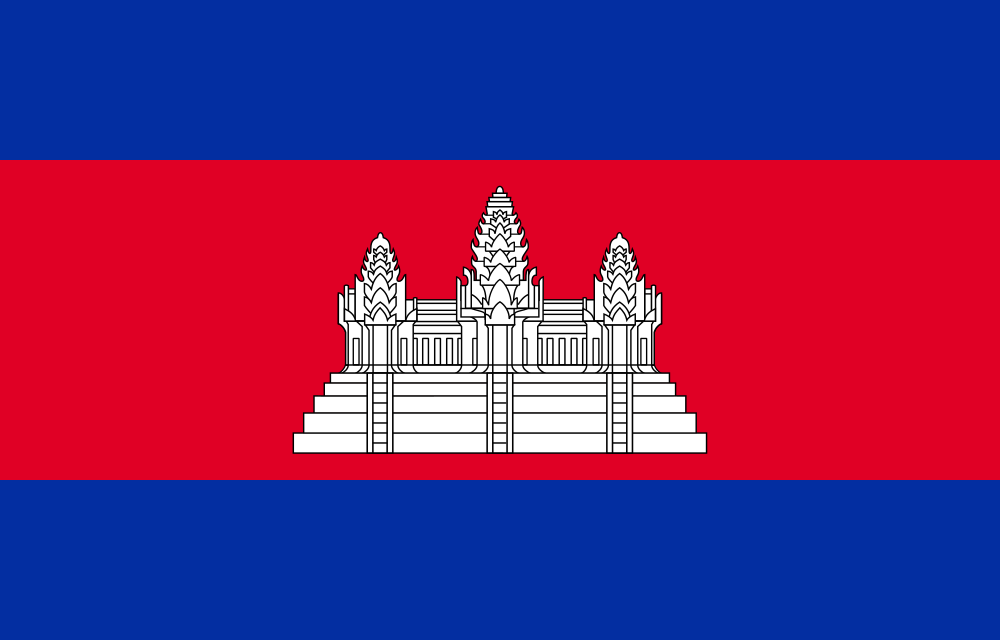
Grammar Focus
- School vocabulary
- Studying and learning verbs
- Expressing ability and progress
- Duration expressions
Course Material
This unit introduces reading and studying activities in the classroom. You will learn vocabulary related to books, flags, designs, and classroom instructions. The unit also covers pre-verbal modifiers used in commands and statements.
Basic Dialogue
| Cambodian (romanized) | English |
|---|---|
| ɛylow yeeŋ niŋ cap mɔel. soum baek siew-phiw khiew. | Now we are going to start reading. Open your blue books. |
| ruup ɛy niw lee króop siew-phiw nih? túŋ ciat khmaɛJ? | What’s the picture on the cover of this book? Is it the Khmer national flag? |
| tee, min-mɛɛn túŋ ciat tee. krón-taɛ cia kumnuu tee. | No, that’s not the flag. It’s just a design. |
| ou, ɛñceŋ? | Oh, is that so? |
| soum baek tumpóa tii-muoy. yeeŋ niŋ cap rien mɔel. | Open to page one. We are going to begin learning to read. |
| yeeŋ cap rien sosee daɛJ? | Are we going to start learning to write too? |
| tee, min tón tee. krón-taɛ mɔel tee. | No, not yet. Only to read. |
| sosee lee siew-phiw baan tee? | May I write in the book? |
| kom sosee lee siew-phiw. prae krodah pseeŋ tiw. | Don’t write in the book. Use a separate (sheet of) paper. |
| prae dooŋ pakaa baan tee? | Can we use a pen? |
| kom prae dooŋ pakaa. prae khmaw-day sruol ciaŋ. | Don’t use a pen. It’s better to use pencil. |
Key Vocabulary
| Cambodian | English |
|---|---|
| cap | to begin, start |
| mɔel | to read, to look at |
| rien | to study, to learn |
| sosee | to write |
| baek | to open |
| tumpóa | page |
| króop | cover |
| túŋ ciat | national flag |
| kumnuu | design, chart |
| krodah | paper |
| pseeŋ | other, different |
| soum | please |
| kom | don’t |
| krón-taɛ | only |
| min tón | not yet |
| cap rien | to start learning |
| prae | to use |
| sruol ciaŋ | better, easier |
| niŋ | will |
| lee | on, in (writing surface) |
Grammar Notes
Pre-Verbal Modifiers
Khmer uses pre-verbal modifiers that belong to specific positions relative to the main verb:
- Before Verb (Class 1): soum ‘please’, kom ‘don’t’, khom ‘try to’, cam ‘wait and’
- Before or After Verb (Class 2): niŋ ‘will’, cap ‘begin’, kit ‘intend’, aoy ‘to let, have’
- After Verb (Class 3): baan ‘can’, haey ‘already’, daɛ ‘also’
These are mutually exclusive within each class. When two or more from Class 2 occur together, they follow the order: niŋ cap, niŋ aoy, kit aoy, etc.
The Modifier /min tón/ ‘not yet’
The modifier min tón ‘not yet’ can occur before or after a main verb and indicates that the action has not yet begun or been completed. It is the opposite of haey ‘already.‘
Practice Drills
Drill A. Identification
| Cambodian | English |
|---|---|
| nih cia túŋ ciat khmaɛJ? | Is this the Cambodian flag (or what)? |
| nih cia kumnuu somrap boŋrien aʔsoo J? | Is this a chart for teaching the alphabet? |
| nih cia ruup thoot look kruuJ? | Is this the teacher’s picture? |
| nih cia phaɛn-tii srok khmaɛJ? | Is this a map of Cambodia? |
| nih cia siew-phiw onglee J? | Is this an English book? |
| nih cia túŋ ciat onglee J? | Is this the English flag? |
Drill B. Fluency Expansion
| Cambodian | English |
|---|---|
| yeeŋ niŋ mɔel. | We’re going to read. |
| yeeŋ niŋ cap mɔel. | We’re going to start reading. |
| ɛylow yeeŋ niŋ cap mɔel. | Now we’re going to start reading. |
| ɛylow yeeŋ niŋ cap mɔel mee-rien tii-18. | Now we’re going to start reading Lesson 18. |
| ɛylow yeeŋ niŋ cap rien mɔel mee-rien tii-18. | Now we’re going to start learning to read Lesson 18. |
| ɛylow yeeŋ niŋ cap rien mɔel mee-rien tii-18, mɛɛn tee? | Now we’re going to start learning to read Lesson 18, aren’t we? |
Mark unit as complete
Track your progress through this course