 Spanish
  French
  German
  Italian
  Portuguese
  Russian
  Chinese
  Japanese
  Korean
  Arabic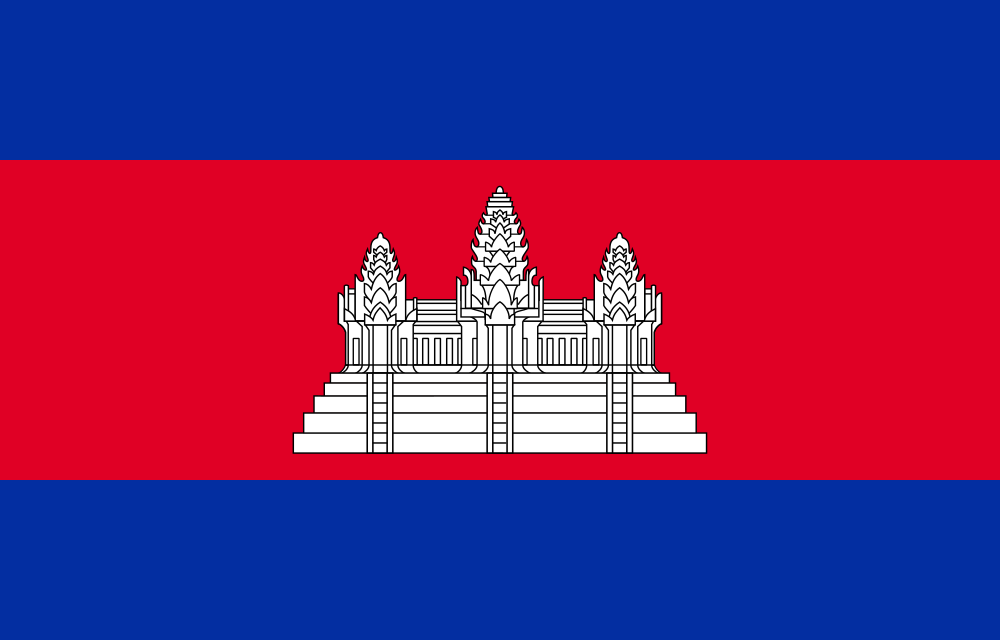
Grammar Focus
- Telling time (maoŋ)
- Daily schedule vocabulary
- Time adverbs (prɨk, lŋiec)
- Habitual actions
Course Material
This unit covers classroom objects such as books, notebooks, pens, and pencils. You will learn to describe objects by color, size, and location, and practice common interrogative words used to form information questions in Khmer.
Basic Dialogue
| Cambodian (romanized) | English |
|---|---|
| siew-phiw mɔkumnóo nih, téŋ-oh pɔmaan? | How many books in all in this pile? |
| baat, mian siew-phiw buon. | There are four books. |
| aamuoy khaaŋ-lee póa ɛy? | What color is the one on top? |
| póa khiew cah. | It’s dark blue. |
| coh aamuoy khaaŋ-kraom póa ɛy? | And the one on the bottom—what color? |
| póa meek. | It’s sky-blue. |
| haey coh aamuoy bontóp pii aakraom kee boŋ-oh? | And how about the one next to the one on the bottom? |
| siew-phiw nuh póa soo. | That book is white. |
| haey coh aamuoy bontóp pii aalee kee boŋ-oh? | And how about the one next to the one on the top? |
| póa lieŋ tum. | It’s orange. |
| coh sʔɛy khmaw nuh, cia siew-phiw mɔel daɛJ? | And that black thing there—is that a (reading) book too? |
| tee, min mɛɛn tee. nuh cia siew-phiw sosee tee. | No, it isn’t. That’s a (writing) notebook. |
Key Vocabulary
| Cambodian | English |
|---|---|
| siew-phiw | book |
| siew-phiw mɔel | reading book |
| siew-phiw sosee | notebook (writing book) |
| póa | color |
| khiew cah | dark blue |
| meek | sky-blue, light blue |
| soo | white |
| lieŋ tum | orange |
| khmaw | black |
| khiew | blue, green |
| krohoom | red |
| lieŋ | yellow |
| mɔkumnóo | pile, stack |
| pɔmaan | how many |
| téŋ-oh | in all |
| khaaŋ-lee | on top |
| khaaŋ-kraom | on the bottom |
| bontóp | next to |
| sʔɛy | thing, what sort of thing |
| né⁹-naa | who |
| ɛy | what |
| ovɛy | what (literary) |
| naa | which |
| tii-pɔmaan | which in a series |
Grammar Notes
Interrogative Words
Khmer interrogative words are categorized by what they replace in a sentence. Words replacing nouns and noun phrases include né⁹-naa ‘who?’, ɛy ‘what?’, sʔɛy ‘what sort of thing?’, and ovɛy ‘what?’ (literary). Words replacing noun modifiers include naa ‘which?’, tii-pɔmaan ‘which in a series?’, pɔmaan ‘how many?’, né⁹-naa ‘whose?’, póa ɛy ‘what color?’, and (yaaŋ) mɛc ‘what kind of?’. Words replacing verbal or prepositional phrases include aɛnaa ‘where?’, troŋ-naa ‘which place?’, (yaaŋ) mɛc ‘how? why?’, thvee ovɛy ‘for what purpose?’, and pɔmaan ‘to what extent?’.
Color Expressions
Colors are expressed with the word póa followed by the color term: póa khiew cah (dark blue), póa meek (sky-blue), póa soo (white), póa lieŋ tum (orange), póa khmaw (black), póa krohoom (red).
Location Words
Position is expressed with khaaŋ- compounds: khaaŋ-lee (on top), khaaŋ-kraom (on the bottom), khaaŋ-sdam (on the right), khaaŋ-chveeŋ (on the left), kondaal kee (in the middle).
Practice Drills
Drill A. Nouns and Noun Phrases
| Cambodian | English |
|---|---|
| sʔɛy niw cɨt khdaa khien? (ruup thoot) | What’s that near the blackboard? — It’s a picture near the blackboard. |
| ne⁹naa niyiey mun kee boŋ-oh? (look kruu) | Who speaks first of all? — The teacher speaks first of all. |
| look kruu suo tiw né⁹-naa? (koun seh tii-bey) | Who is the teacher asking? — The teacher is asking the third student. |
| sʔɛy niw kraoy khnooŋ khñom? (siew-phiw mɔel) | What’s that behind me? — That’s a book behind you. |
| koun seh niŋ rien thvee ɛy? (rien khmaɛ) | What’s that student doing? — The student’s studying Khmer. |
| look mɔel ɛy? (kumnuu) | What are you looking at? — I’m looking at a chart. |
Mark unit as complete
Track your progress through this course